
Philosophical Clarity

Matters of Value

Objective Truth

In the middle of the 18th century, the Scottish philosophy David Hume looked carefully at the ways in which a statement can be true. He found two possibilities:1

  • Statements can be true through logical consistency. Hume called these “relations of Ideas”. Truths are of this type, such as mathematical truths, can be verified by thought alone.
  • Statements can be true because they accurately reflect what the world is like. Hume called these “matters of fact”. Scientific truths and most of our common sense understanding of the world are of this type and they can be checked through observation.

Subjective Truth

Hume had already noticed that there is a profound difference between both of these types of objective truth and evaluative statements. Whereas objective statements take the form is or is not, evaluative statements involve a sense of ought or ought not.2

Two centuries later, A J Ayer took this analysis one stage further. He showed that the evaluative and ethical components of statements don’t convey anything that can be proved to be true or false. What they do is show our feelings or sentiments. They express approval or disapproval.3

It seems that our beliefs about value, duty and purpose can’t be proved by observation, or by thought alone. They are subjective.

The Observable World

True statements about matters of fact always refer to the details of what this shared universe of ours is like — details which are always on public display, open to observation by anyone who has the wherewithal to make the necessary observations.

All that science says is objective in this way. Its statements can always potentially be checked by observation, though it might take considerable ingenuity to develop the method for checking them.

Most of our everyday knowledge is like this too. We might, for instance, know that if we try to cook an omelette on a very hot pan, the surface of the omelette will burn before the centre is cooked through. Anyone with some eggs and a hob could check whether or not this is the case.

If we find that our beliefs aren’t a good match for reality — that what we believe is not actually the case — we can put our obsolete ideas behind us and search for a better way to see things.

Mathematical Truth

The truths of mathematics and logic may not be about the realm of experience, but they’re objective too, for they define the landscape of what can be coherently thought. Anyone who explores the appropriate area of the thinkable can check whether or not a particular statement is true.

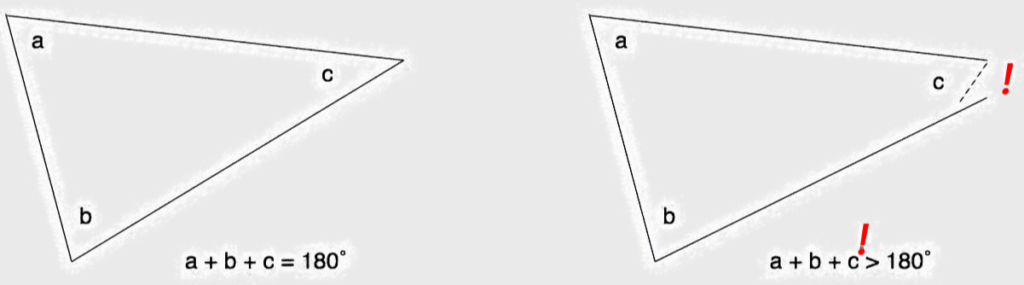
Take, for example, triangles. We can imagine a vast range of three-sided figures drawn on a flat surface, all of which would have three internal angles of various sizes. The figures whose internal angles add up to 180˚ would have their sides meeting at all three corners. They would be coherently thinkable. But if the angles added up to less or more than 180˚, the sides couldn’t join at any coherent set of corners. At least one of the angles wouldn’t be an angle at all. The figure would fail to be a viable triangle.

Similarly, the only truly viable square root of 9 is 3. If a mathematician tried to make the square root 2.9 or 3.2 there would be no way they could multiply the number by itself to generate 9 again. The geometry of their thinking would collapse in on itself. It wouldn’t be structurally sound enough to be stable.

The Subjective

Statements about value, or about duty or purpose, form a distinct third family of statements that can’t be verified by either thought alone or observation.

It isn’t possible to show that valid ethical concepts are coherently thinkable while invalid ones are not. History, sadly, shows that some of the most monstrous ways of thinking are perfectly thinkable, such as the Nazis’ ideas of racial hierarchy, ‘living space’ for true Germans, and ‘life unworthy of life’.4

It isn’t possible, either, to measure how good a thing is directly, or to correlate the good with any set of observable features of the universe.

  1. “All the objects of human reason or enquiry may naturally be divided into two kinds, to wit, relations of ideas, and matters of fact. Of the first kind are the sciences of geometry, algebra, and arithmetic, … That the square of the hypotenuse is equal to the square of the two sides, is a proposition which expresses a relation between these figures … Matters of fact … are not ascertained in the same manner.” David Hume, Enquiry Concerning Human Understanding, Section IV, Part I, 1748.
  2. “In every system of morality, which I have hitherto met with, I have always remark'd, that the author proceeds for some time in the ordinary way of reasoning, and establishes the being of a God, or makes observations concerning human affairs; when of a sudden I am surpriz'd to find, that instead of the usual copulations of propositions, is, and is not, I meet with no proposition that is not connected with an ought, or an ought not.” David Hume, Treatise of Human Nature, Book III, part I, 1740.
  3. “If I say to someone ‘You acted wrongly in stealing that money’, I am not stating anything more than if I had simply said, ‘You stole that money’. In adding that this action is wrong, I am not making any further statement about it. I am simply evincing my moral disapproval about it. It is as if I had said, ‘you stole that money’, in a peculiar tone of horror, or written with the addition of some special exclamation marks. The tone, or the exclamation marks, adds nothing to the literal meaning of the sentence. It merely serves to show that the expression of it is attended by certain feelings in the speaker. If I now generalise my previous statement and say ‘Stealing money is wrong’, I produce a sentence which has no factual meaning - that is, expresses no proposition that can be either true or false.” A. J. Ayer, Language, Truth and Logic, London: Penguin, 2001, p. 110 (first published in 1936).
  4. One of the main architects of the holocaust was Heinrich Himmler — the commander of the SS and the Gestapo and the founder and officer in charge of the death squads and concentration camps — and he saw the extermination of the Jewish race in moral terms. He believed that it was the duty of his men to implement the ‘Final Solution to the Jewish Question’, and that their feelings of disgust at what they were doing was just a moral weakness that had to be overcome. He put it this way in a speech to SS major-generals in 1943: “Most of you must know what it means when a hundred corpses are lying side by side, or five hundred, or a thousand. To have stuck it out and at the same time (apart from exceptions caused by human weakness) to have remained decent fellows, that is what has made us hard. This is a page of glory in our history.” [Roger Manvell and Heinrich Fraenkel, Himmler, London: Nel Mentor, 1973, p. 146-7.] Himmler’s personal masseur described him as a man who was “so overlaid with rules and regulations which he invented or which were imposed upon him that nobody, not even his closest relations, could have got anything out of him which ran counter to them” [Ibid., p. 198]. Himmler was clearly following ethical rules and doing what he believed to be his duty, yet few people would assert that his actions and beliefs were anything but repugnant.