Philosophical Clarity

Mental Events

Aboutness

For a baby, time is circular. The same things keep coming round and round – the mother’s face, her nipples, periods of darkness and light, the father’s face, voice tones that comfort and soothe. Hunger. Milk. Sleep. Hunger once more.

Babies soon learn to pick out familiar elements from these recurring rhythms. Particular patterns of brain activity become associated with the appearance of a particular thing. So, when the baby learns to summon up clusters of activated nerve circuit — thoughts — and make them the focus of their awareness, the clusters of circuit can be used to represent the things they are associated with.

The activated circuits then gain a dual significance. Not only are they events in their own right, they also stand for things. They are about them, as it were, and it is this ability of brain events to be about events in the world beyond the brain that gives them much of their peculiar mental character.1

In philosophy, this quality of aboutness is traditionally called ‘intentionality’,2 from the Latin verb intendere, meaning to point at, or to stretch towards or be directed towards. The mental elements seem to reach out towards the patterns of event that they are associated with.

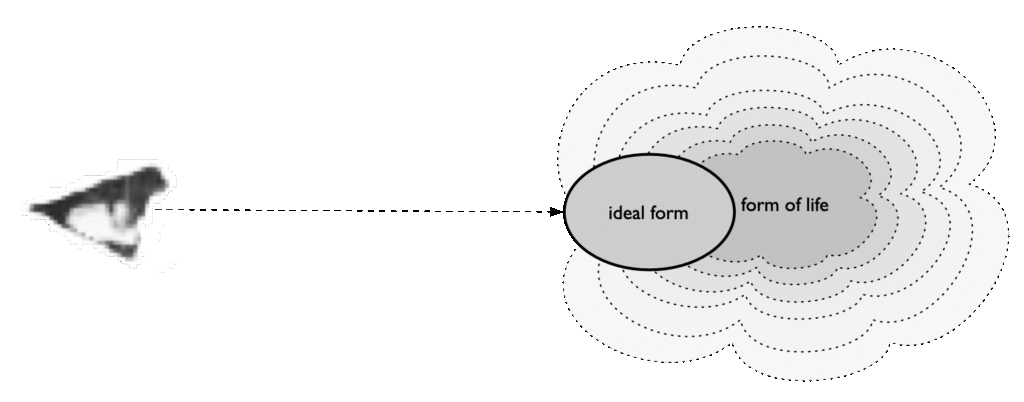
Forms Of Life

The patterns of event that thoughts are about are rarely simple. What makes an animal a ‘dog’, for instance, is not straightforward. Some ‘dogs’ have long hair, others short. Some are tall and slim while others are short and stocky. Some are timid, others boisterous. But there is a network of similarities between them, what Wittgenstein called family resemblances – sometimes a likeness in overall form and sometimes a likeness of detail. There can be a similar set of eye, nose, mouth and ear; a similarity in the way the animals run and walk; or the way they wag their tails; or the way they fetch balls, or walk up to a child hoping to be petted.3

These patterns of event occur in the body of reality — of life — so let’s make this prominent by adopting Wittgenstein’s phrase ‘forms of life’ for them4

Ideal Forms

As a child spends more and more time with dogs, she will gradually build up a sense of the doggy possibility space until she has an idea-space in her mind that models many of the possibility-space’s features.

We need a name for clusters of inter-connected perceptions and realisations of this kind. Plato used the terms eidos (form) an ἰδέα (idea) interchangeably to talk about the entities that inhabited the timeless plane of thought and that he believed made up the ultimate realities of the world.efn_note]https://en.wikipedia.org/wiki/Theory_of_forms#Etymology[/efn_note] So it seems appropriate to call them ‘ideal forms’.

It is the doggy ideal form that the child uses in her thinking about ‘dogs’. It corresponds to the associated form of life – it is about the form of life – and it can expand and evolve every time that its correspondence to the form of life of dog is challenged.

A little later, when the child has learnt to attach words to ideas, she can tag the dog ideal-form she has built up with the label ‘dog’. This enables the child to bring to bear all the understanding of dogginess she has garnered to her dealings with any animal she encounters which seems to fit the ‘dog’ space. The information encoded in the child’s idea-dog helps her respond to real dogs more effectively.

Aboutness

Maps

In practice, we use the ideal forms in our heads as maps.

  • They help us to identify and locate the most important features of the reality around us.
  • They keep us oriented within the physical structures of the world, and within the social structures that form such an important part of the environment in which we live.
  • They make it possible for us to navigate reality towards the possibilities in which we, and those we care about, can flourish.

  1. “We may, therefore, consider the intentional in-existence of an object to be a general characteristic of mental phenomena which distinguishes this class of phenomena from the class of physical phenomena.” Franz Brentano, Psychology from an Empirical Standpoint, London: Routledge, 1995, p. 91.
  2. Franz Brentano introduced the concept of intentionality to modern Western philosophy. “Every mental phenomenon is characterized by what the Scholastics of the Middle Ages called the intentional (or mental) inexistence of an object, and what we might call, though not wholly unambiguously, reference to a content, direction toward an object (which is not to be understood here as meaning a thing), or immanent objectivity. Every mental phenomenon includes something as object within itself.” Ibid., p. 88.
  3. Cf. Ludwig Wittgenstein, Philosophical Investigations, Oxford: Blackwell, 2001, §66 & §67.
  4. Wittgenstein used the phrase ‘form of life’ in his later philosophy:<br>

    • to indicate that language is part of the flow of reality and not only a rational system of ideas [“To imagine a language is to imagine a form of life.” Ludwig Wittgenstein, Philosophical Investigations, Oxford: Blackwell, 2001, § 19 “The term ‘language-game’ is meant to bring into prominence the fact that the speaking of language is part of an activity, or of a form of life.” Ibid. § 23.’].<br>
    • to point out the complexity of the patterns that exist within human lives [“One can imagine an animal angry, frightened, unhappy, happy, startled. But hopeful? And why not? A dog believes his master is at the door. But can he also believe his master will come the day after tomorrow?– And what can he not do here?–How can I do it?–How am I supposed to answer this? Can only those hope who can talk? Only those who have mastered the use of a language. That is to say, the phenomena of hope are modes of this complicated form of life.” Ibid., p. 174.].<br>
    • to remind us that what the philosopher must ultimately attempt to deal with is the reality of the world [“What has to be accepted, the given, is–so one could say–forms of life.” Ibid., p. 226].