Escaping Bewitchment
All traditional logic habitually assumes that precise symbols are being employed. It is therefore not applicable to this terrestrial life, but only to an imagined celestial existence.
— Bertrand Russell1
Duck-Rabbits
In April 1948, Wittgenstein went to live in north Connemara, a rural and remote area on the west coast of Ireland. He lived alone in a two-room cottage that looked out over the sheltered waters of Killary Harbour, Ireland’s only fjord, with the steep sides of Mweelrea on the opposite shore and a sparsely-populated peninsula of rugged hills, bog and rough grazing behind him.
He used to like going for walks, not only to gain the physical benefits of exercise and to enjoy the magnificent scenery, but also because the walking sometimes helped him to think clearly. Nietzsche once wrote, “Sit as little as possible. Credit no thought not born in the open air and while moving freely about — in which the muscles too do not hold a festival,”2 and, though Wittgenstein wasn’t much influenced by Nietzsche, he sometimes felt a little that way himself. Walking could now and again free him from the stale old thoughts that would keep coming back round when he was working at his table.
Sometimes, when he was walking, he would stop and draw a picture of a duck-rabbit in the peaty ground that he was walking upon. Then he would gaze at the picture, watching the way it would first reveal a duck, then a rabbit, then a duck once more, and he would try to mine this odd phenomenon for insight into the nature of perception and thought.
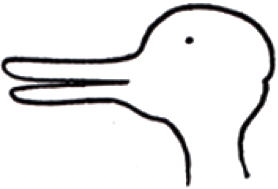
He was fascinated most of all by the moment of apprehension. In an instant the figure would seem to change its identity completely and all at once turn into something that it hadn’t been a moment beforehand. Yet it hadn’t been touched.
It would make him think of music – many things would make him think of music – for was this not a little similar to how a person might suddenly understand a piece of music? Or a joke? They get it. They twig. An intact whole appears where before there was nothing.
Aspect Seeing
Wittgenstein called this ‘aspect-seeing’, for a person would suddenly see an aspect of reality that had until then lain hidden. The moment of apprehension was the ‘dawning’ of the aspect, and people who were unable to see an aspect – who couldn’t appreciate the music the way it was supposed to be appreciated, or who couldn’t see the duck, or the rabbit, or get the joke – were ‘aspect-blind’.
One of the most curious facets of aspect-seeing is that the aspect either appears as a whole or doesn’t appear at all. Either you see the rabbit or you don’t. Either you get the joke or you don’t. If the perception comes, it is of a bounded whole.
Seeing As
Aspect-seeing arises whenever it is possible to recognise something as a particular identity. In the moment of recognition, the form of life (which exists within the flow of reality) will become yoked to the ideal form (that exists in the space of possible thoughts). A raised bit of land will become a ‘hill’, even if it is not particularly high, and for as long as we are seeing it as a hill we will perceive the qualities that it has in common with other members of the hill family.
This seeing of things as objects works well, on the whole, for it allows us to recognise things quickly and decisively, and to think complex thoughts about them.
Boundaries
As soon as we notice that a thing as a particular entity, it seems to light up with the ideal form inside it. And things either light up this way or they don’t. There is no halfway.
One result of perceiving in this way is that what we perceive is objects. We see things as discrete items that are separate from their environment.
We can understand this through appreciating that our ideal forms must necessarily be bounded. A bounded ball of meaning is easy to manipulate mentally. We can take one particular ball of meaning, for instance ‘rabbit’, and set it in particular relationships with other balls of meaning – ‘forest’, ‘warren’, ‘carrot’. But if we tried to think in terms of the fluffy tails, of little noses sniffing the air, of long teeth nibbling at shoots, and of short brown fur without all these images being held together in a unified and discrete bundle, it would be impossible to make anything but the simplest of connections. The threads of meaning would get hopelessly tangled as we thought.
The words we used are atomic. They are bounded wholes. A sound either is or is not an example of a particular word. If the words weren’t bounded wholes, we wouldn’t be able to juggle them so easily and slot them into place in the sentences we speak.
There are often no definable boundaries between forms of life, however. Woody plants exist in a continuum between the tall and the short, so there is no obvious line of demarcation between ‘tree’ and ‘shrub’, or between ‘tree’ and ‘seedling’. And day slides gradually into night. Some hours later it gradually becomes light enough again for most people to consider that it to be ‘day’ once more, but there is no clear moment when day becomes night, or night day.
Complexity
There is a second reason why the correspondence between ideal form and form of life is often imperfect.
When we try to understand a phenomenon through any single conceptual schema, to see it as something in particular, we only see a fraction of what is there. Even a simple triangle “can be seen as a triangular hole, as a solid, as a geometrical drawing; as standing on its base, as hanging from its apex; as a mountain, as a wedge, as an arrow or pointer, as an overturned object which is meant to stand on the shorter side of the right angle, as a half parallelogram, and as various other things”.3
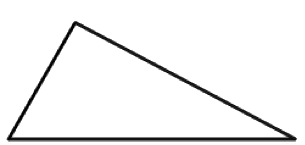
We can understand this in terms of possibility space. The possibility-space of the triangle is larger and more complex than any single idea-space that can be projected onto it. Any example of a real triangle will sit within the triangle possibility-space, and one chamber of possibility – for instance the arrow – will be connected with others, such as the half parallelogram. All the varied potentialities and properties run through the form of life of the triangle without there being any real barrier or boundary between them.
This contrasts with the ideal forms that we might want to project on to a triangle, for one idea-triangle is often incompatible with the others. We can’t, at the same time, see the triangle as a ‘mountain’ and as a ‘wedge’. The instant that we see the triangle as something in particular, and it becomes an object, we become blind to all the features of the triangle that aren’t the properties of the particular object we are perceiving.
This seeing of things as objects works well, on the whole, for it allows us to recognise things quickly and decisively, and to think complex thoughts about them.
The Veil of Idea
It is as if our ideas conjured up a veil that sits between us and the world — a veil of idea that attaches itself to the things of the world and shows them to us in terms of their ideal counterparts, a triangle as a wedge or a duck-rabbit as a rabbit. Whenever we are thinking about the world as we look at it, it is the veil we see — ‘wedges’, ‘triangles’, ‘rabbits’, ‘dogs’ and ‘chairs’ — and not the world itself beyond them. So, since the ideal forms that make up the veil have boundaries around them, we see the world as an array of bounded objects, whether or not the world is indeed made up of things that are bounded and separate. The reality of the duck-rabbit, for example, is not object-like; it is a form of life that contains both duck and rabbit possibilities within it as part of a seamless whole. It is only when we see a duck-rabbit as a rabbit that it adopts the appearance of an object which no longer has duckness as part of it.
We can think of the duck-rabbit as a landscape whose features can be identified using two mutually incompatible maps. When we use either of these maps to understand the landscape, we see its features according to that map’s particular interpretation of them.
Whenever we see things as particular entities, the maps projected onto the world become clear and precise. This helps us to understand the world and makes it possible to think logically about what we are seeing, but it also creates a particular hazard that it is all too easy to fall into. When the veil of idea solidifies into something clear and sharp before our eyes – when we feel we understand the world – it is natural to think that the reality of the world is exactly as we understand it to be.
This seeing of things as objects works well, on the whole, for it allows us to recognise things quickly and decisively, and to think complex thoughts about them.
The Map-Territory Fallacy
Wittgenstein once wrote that “philosophy is a battle against the bewitchment of our intelligence by means of language,”4 and the confusion between map and world – between imagined object and real aspect, between veil and reality – is precisely the sort of mental trap that he believed we must fight against if we are to “see the world aright”.5
It is such a fundamental and widespread source of confusion that it deserves its own name, and as this fallacy is one of mistaking the ideas that form our mental maps with the territory our ideas are about, we can call it ‘the map-territory fallacy’.
We slip into this fallacy whenever we look at the world and think that the array of ideal forms we perceive is identical to what is actually there — the ocean of forms of life that lie behind and beyond our perceptions.
- Bertrand Russell, Vagueness, The Australasian Journal of Psychology and Philosophy, Vol. 1, June 1923 (pp.84-92), reprinted in Bertrand Russell (John G Slater ed.), Essays on Language, Mind and Matter 1919-26, London: Unwin Hyman, 1988, p.151.
- Friedrich Nietzsche, Ecce Homo: How One Becomes What One Is, Harmondsworth: Penguin, 1979, p. 54.
- Ludwig Wittgenstein, Philosophical Investigations, part 2, Oxford: Blackwell, 2001, p. 200.
- Ludwig Wittgenstein, Philosophical Investigations, Oxford: Blackwell, 2001, §109.
- Ludwig Wittgenstein, Tractatus Logico-Philosophicus, London: Routledge & Kegan Paul, 1961, 6.54.